The Transformation of Tajikistan by John Heathershaw Edmund Herzig
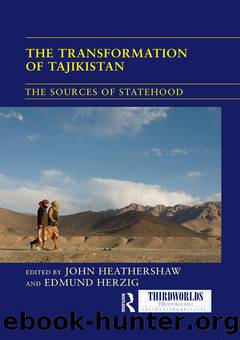
Author:John Heathershaw, Edmund Herzig [John Heathershaw, Edmund Herzig]
Language: eng
Format: epub
ISBN: 9780415500159
Barnesnoble:
Goodreads: 13710934
Publisher: Routledge
Published: 2012-10-01T00:00:00+00:00
Hizb ut-Tahrir al-Islami
In the late 1990s, small clandestine cells of Muslim activists in Central Asia began to refer to ideological concepts distributed by the London-based âvirtualâ28 Islamic association Hizb ut-Tahrir al-Islami. It is beyond the scope of this paper to give a satisfying introduction to HT or research relating to it.29 However, Turajonzodaâs refutation of HT deserves some attention since he is the first Tajik official with a more nuanced approach to HT. Firstly, he refers to several pamphlets distributed by HT and offers a detailed analysis of central aspects of HTâs programme concluding that it does not comply with central Islamic teachings (Turajonzoda 2006, p. 146).30 Secondly, Turajonzoda rejects the government statements that HT recruits followers predominantly among the Uzbek minority in Tajikistan, stressing the involvement of Tajiks (ibid., p. 123). Thirdly, he admits that the exclusively security-driven approach of the governments of Central Asia is one of their âweak points (nuktai zaifi davlathoi Osiyoi Markazi)â (ibid., p. 144) and is inadequate to deal with the complex ideology of HT (ibid., p. 124).
Turajonzoda methodically repudiates central theses of HTâs ideology referring mostly to the Koran, hadith and a selection of Hanafi textbooks. He counters HTâs postulate that democracy is an alien concept in Islam with a lengthy interpretation of the Sura ash-Shura (42:38) demonstrating that Islam has its own genuine democratic tradition (Turajonzoda 2006, pp. 125ff.). While HT demands the abolition of private property and the return to a centrally planned economic system, Islam supports and protects individual property rights and economic activity (ibid., p. 126). Furthermore, HTâs ideology is based on intolerance and rejects the idea that different cultures and civilizations could co-exist in peace, while Islam actually facilitated the coexistence of various ethnic and religious groups by establishing a social order based on tolerance (tahammul) and moderation (eâtidol) (ibid., pp. 128â131).31 Finally, Turajonzoda criticises HTâs political objective of re-establishing the Caliphate since this would imply the abolition of nation-states. The concept of the modern nation-state, Turajonzoda continues, is the fundamental political and spiritual value of human societies. In particular, he argues that the Tajik nation, which regained independence in 1991 after more than 1000 years (since the Samanids), understands the importance of its own statehood (davlatdori) since it guarantees peace (sulh) and stability (oshti). Here Turajonzoda is not arguing within a traditional Islamic framework of reference but merging this with the nationalist sentiment that has been consolidated since the late 1980s. Considering the convergence of national and Islamic values, Turajonzoda concludes, HT violates fundamental principles of Hanafi Sunni Islam since it attempts to create a division within Tajik society (ibid., pp. 140â143). Previously, Turajonzoda even elevated Tajikistanâs statehood and independence to a manifestation of Godâs grace (fazli khudavand) (ibid., p. 7), therefore accusing HT of the ultimate political, but also religiously charged, crime.
Turajonzodaâs otherwise remarkably coherent analysis of HT eventually takes an idiosyncratic twist. Discussing the origins of HT, he argues that HT is not particularly successful (or even active) in the Middle East. Only in countries under the influence of Freemasons and Zionists (Turajonzoda 2006, p.
Download
This site does not store any files on its server. We only index and link to content provided by other sites. Please contact the content providers to delete copyright contents if any and email us, we'll remove relevant links or contents immediately.
| Anthropology | Archaeology |
| Philosophy | Politics & Government |
| Social Sciences | Sociology |
| Women's Studies |
Cecilia; Or, Memoirs of an Heiress — Volume 1 by Fanny Burney(32638)
The Great Music City by Andrea Baker(32610)
Cecilia; Or, Memoirs of an Heiress — Volume 2 by Fanny Burney(32013)
Cecilia; Or, Memoirs of an Heiress — Volume 3 by Fanny Burney(31997)
We're Going to Need More Wine by Gabrielle Union(19110)
All the Missing Girls by Megan Miranda(16328)
Pimp by Iceberg Slim(14679)
For the Love of Europe by Rick Steves(14587)
Bombshells: Glamour Girls of a Lifetime by Sullivan Steve(14138)
Norse Mythology by Gaiman Neil(13459)
Talking to Strangers by Malcolm Gladwell(13445)
Fifty Shades Freed by E L James(13293)
Mindhunter: Inside the FBI's Elite Serial Crime Unit by John E. Douglas & Mark Olshaker(9421)
Crazy Rich Asians by Kevin Kwan(9349)
The Lost Art of Listening by Michael P. Nichols(7551)
Enlightenment Now: The Case for Reason, Science, Humanism, and Progress by Steven Pinker(7356)
The Four Agreements by Don Miguel Ruiz(6837)
Bad Blood by John Carreyrou(6675)
Weapons of Math Destruction by Cathy O'Neil(6371)
